California Intellectual Property Blog

Background image

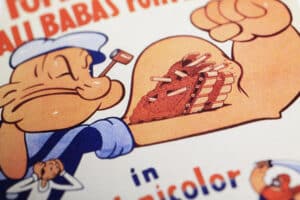
Popeye Enters Public Domain, But a Trademark Fight Is Brewing

Popeye trademark issues arise after character enters public domain.

Generations of children grew up enjoying Popeye the Sailor Man. That’s why it was big news when the character’s copyright registration expired in January 2025. At that point, the original incarnation of the quasi-superhero could be used by anyone in the public domain. However, a recent filing shows that the Popeye trademark may still offer some protection.

A trademark opposition filed by the character’s owner, Hearst Holdings, Inc., alleges that a wrestling company is trying to misuse its intellectual property. Freedom Pro Wrestling filed an application to register the term “Popeye” just nine days after the Popeye copyright expired. The U.S. Patent and Trademark Office (USPTO) published the application after an initial denial.

At that point, it seems the owners of the Popeye trademark ate their spinach and got ready for a fight.

Does the Popeye Trademark Still Have Protection?

It’s important to note that the expiration of a brand’s copyright does not affect its trademark rights. This became abundantly clear during Disney’s effort to protect Mickey Mouse, even after the character’s copyright expired. While there’s nothing to stop anyone from using the original Mickey Mouse – or Popeye, for that matter – trademark rights do still provide some protections.

For instance, the Popeye trademark prevents anyone from using the term “Popeye” in a way that might confuse consumers. Hearst Holdings does not own the word “Popeye.” This means other brands may be able to use the character’s name and likeness in a variety of ways. The only issue arises if such use could create a likelihood of confusion or trademark dilution.

That’s precisely what Hearst Holdings claims will happen if the wrestling organization receives the Popeye trademark.

Is This a Valid Trademark Opposition?

When the USPTO initially received Freedom Pro Wrestling’s trademark application, an examining attorney refused the application with a non-final action. This refusal was related to the existing rights of Hearst Holdings. However, the wrestling company altered its application to specify specific venues where it would use the Popeye trademark.

This was apparently enough to assuage the concerns of the USPTO. The application was published in the Official Gazette for an opposition period. This is an important part of the trademark timeline, and it’s where Hearst Holdings took note. In its opposition filing, the company claims that registration would confuse consumers.

The owner of Popeye claims that consumers may believe the services offered by Freedom Pro Wrestling are somehow related to the existing Popeye trademark. The holding company also claims that registration of the name will result in trademark dilution. Put simply, this means the strength of the existing trademark would be diminished in consumers’ minds.

So, what can we expect next?

The Road Ahead

Now that Hearst Holdings filed an opposition notice, Freedom Pro Wrestling has until April 13, 2026, to submit a response. If they do so, this will begin a process with the Trademark Trial and Appeal Board (TTAB). Both sides will have an opportunity to argue its case. The case could extend far into 2027, and if one side doesn’t accept the conclusion, a lawsuit could be filed.

However, it’s possible that Freedom Pro Wrestling will not submit a response. In this situation, they will have abandoned their application and secured no rights over the Popeye trademark. This is a common outcome, particularly when smaller organizations face off against massive corporations. However, the wrestling group may have a case if they move forward.

In its filing, Hearst Holdings makes a broad claim about confusion. It says confusion would exist because wrestling involves fighting – and Popeye is “at least after eating spinach, good at” fighting. The result of this case will rely on whether the company can prove that consumers might confuse wrestling services with its existing Popeye trademark.

In light of their considerable resources, it’s a fair assumption that Hearst Holdings will be “strong to the finish” in this case.


Battle Emerging Over Who Owns the “Sound of Freedom” Trademark

QAnon film favorite "Sound of Freedom" encounters another legal issue, this time with trademark rights.

Plenty of films gain widespread attention once they hit the box office. However, few garner that attention in the same way that “Sound of Freedom” did. While the movie may have initially gotten noticed due to its underlying political message, it’s currently in the news due to an emerging trademark dispute revolving around who can use the film’s title.

In July 2023, DN Marks LLC filed a trademark application seeking rights over “Sound of Freedom” in regard to graphic novels, film production, celebrity appearances, and other goods and services. Almost exactly one year later, Sound of Freedom Movie LLC filed a similar application seeking trademark rights over the title for film production only.

As if the film didn’t generate enough controversy, this dispute looks like it could get messy.

The Battle for the ‘Sound of Freedom’ Trademark

While sound of Freedom Movie, LLC took nearly a year after the release of the film to file a trademark application with the USPTO, it recently filed a trademark opposition against the “Sound of Freedom” trademark application by DN Marks LLC so it appears they are serious about their effort.

Of course, this raises the question of who DN Marks LLC is and who it represents. A cursory trademark search shows that the company owns over 100 trademarks in a variety of areas — including film production. Interestingly, its application for “Sound of Freedom” was filed only days after the film initially hit the big screen.

The preexisting trademarks owned by DN Marks LLC do not necessarily mean they’re the rightful owners of the film’s title. And while some trademark disputes seem to stem from misunderstandings or similar names — the fact that both applications focus on stories of human trafficking seems to indicate that the two parties are fighting over the same intellectual property.

Mounting Legal Issues for “Sound of Freedom”

When ‘Sound of Freedom’ was released, many viewed it as a means to further the QAnon conspiracy theory. The film tells the story of human trafficking victims, but it seems to play into the tropes of the conspiracy movement in many ways. This caused a tremendous amount of debate online, but once that died down, the film’s legal issues began to mount.

While the film was well-received among conservative audiences, information eventually emerged showing that the supposed “true story” behind the film was greatly embellished. This story was told by Tim Ballard, an activist who has since been removed from organizations that he founded due to allegations of sexual assault.

The alleged criminal acts aren’t where the legal troubles end. In addition to several lawsuits targeting Ballard, cases have been filed against the media companies involved in what Rolling Stone called “mythologizing his exploits.” The current trademark opposition filed by Sound of Freedom Film LLC is just another trouble in the film’s growing list of issues.

Can You Trademark a Film Title?

Similar to trademarking a book title, securing trademark rights over a single film title with no other use is difficult.  A trademark for a series of films is permitted by the trademark office since the name then becomes a source identifier for more than just a single work.   Separately, the owner of a film can copyright the creation — a copyright that Sound of Freedom Film LLC claims to own.

In this case, it seems like the company may be looking to do more than a one-off film. There’s already talk of a potential sequel. Of course, even the news of a potential sequel came with debate over who actually owns the rights to a potential sequel.

The current trademark dispute between Sound of Freedom Film LLC and DN Marks LLC is interesting because DN Marks clearly believed that it had rights over the title as soon as the film was released, and the claimed owner of the copyright only came forward seeking a trademark a full year later.

There’s definitely a lot more to figure out about this case, but it seems to indicate that “Sound of Freedom” is having trouble in almost every area of the law one could imagine.

The Wordle Trademark Is Being Fought Over… Again

There's another dispute over the Wordle trademark unfolding.

Anyone who is even slightly up to date with pop culture has undoubtedly encountered the Wordle game. Originally created by Josh Wardle, the viral sensation became so popular after its release that The New York Times announced that it had purchased the game in January 2022. Since that time, the company has gone to great lengths to protect the Wordle trademark.

In what may be the most high-profile dispute to date, the media company that now owns Wordle has filed a trademark opposition against University Games Corporation. In March 2023, University Games filed a trademark application for “5 LETTER WORDLET.” This is the name of its board game that bears a striking resemblance to Wordle.

However, it’s not the resemblance that’s causing issues.

The Constant Fight for the Wordle Trademark

In the trademark opposition filed by The New York Times, there’s no significant mention of the gameplay utilized in the 5-Letter Wordlet board game. This may be surprising to some since the two games bear striking resemblances. Instead, the Wordle owner focused entirely on the name of the board game — a name that incorporates the Wordle trademark in its entirety.

While the names of these games may seem different enough, it quickly becomes obvious that University Games merely added the letter “T” to the end of the Wordle mark. Of course, there’s no question as to who first used the trademark. The trademark registration filed by University Games claimed a first use date of October 2022 — long after the June 2021 first use of “Wordle.”

Put simply, The New York Times believes registration of “5-Letter Wordlet” would create a likelihood of confusion among customers due to its name. It’s encountered several similar issues where copycat games made use of its brand name. Of course, this is far from the only issue that could create significant confusion among consumers.

How Do Wordle Copycats Get Away With It?

While being a board game differentiates 5-Letter Wordlet somewhat from Wordle, the gameplay mechanics similarities are undeniable. Players get six opportunities to guess a five-letter word. Each guess provides additional hints by telling players which letters are in the word, telling them which letters are not, and giving clues on where each letter might be located.

Some consumers may question how two companies could own such similar games. This is possible for a variety of reasons. First, no one can really own the idea behind a game. There were several other five-letter word guessing games before Wordle, and there are plenty out there right now. The New York Times says it has no problem with these games.

While game ideas cannot typically be copyrighted, the mechanics used can secure copyright registration. This leads to a second point that could provide protection to University Games, and that’s the fact that they have unique mechanics in their version of the game. This could safeguard them from copyright infringement claims — but trademark infringement is a completely different issue.

What Happens Now?

The New York Times owns the Wordle trademark. There’s no dispute over that fact. In its filing with the U.S. Patent and Trademark Office (USPTO), the company claims that registration of “5-Letter Wordlet” would create confusion among consumers. If you look at the reviews on the Amazon listing of the board game, it quickly becomes apparent that this is a distinct possibility.

Here’s just one review showcasing potential issues: “I bought this game hoping that it would be an at-home version of the online Wordle. It isn’t exactly the same, but fun in a different way…” Clearly, consumers might assume the two games are the same.

The gaming company will have to answer to claims of trademark infringement. If they decide to fight the case, they currently have until July 28, 2024 to file an answer with the USPTO. There’s no way to guarantee a specific outcome, but it’s hard to envision a scenario where such a similar game with a similar title is allowed trademark registration.


Copyright Office Joins War on AI Intellectual Property

Artificial intelligence copyright, artificial intelligence intellectual property

Discussions regarding artificial intelligence (AI) have been going on for years. However, it’s only recently that these discussions have become a major part of the zeitgeist. With the public release of ChatGPT and similar tools, people have quickly recognized the power of this emerging tech. However, there are major questions arising regarding artificial intelligence and intellectual property (IP) rights.

One of these questions is whether a human can claim IP rights over content generated by artificial intelligence. There are clearly many other issues arising around the tech, but regarding AI and copyright registration, it seems that the U.S. Copyright Office has taken a side. Surprisingly, it’s not the side that many observers would have expected — so more questions are undoubtedly on the horizon.

Copyright Office Issues Guidance on AI Intellectual Property

Early in 2023, the U.S. Copyright Office released a guide stating that works created using artificial technology could receive copyright protection. However, this guidance was contingent on the content having “sufficient human authorship to support a copyright claim.” This was an exciting moment for artificial intelligence content creators, a subset of artists who are increasingly finding their way into artistic conversations.

However, it seems that the guidance provided by the U.S. Copyright Office has yet to be put into practice. As of December 2023, the government had rejected a chain of applications that sought protection for artificial intelligence related intellectual property. One of its latest rejections went to Ankit Sahni — a man who took a photograph of a sunset and then modified the image using the RAGHAV Artificial Intelligence Painting App.

To create the new image, Sahni claimed he input various parameters into the AI tool to create a new piece of art. The final product was an artistic rendition of his own photograph made to resemble Van Gogh’s The Starry Night. Sahni argued that the image was copyrightable because he took the original photograph, designated the desired style, and chose which variables RAGHAV would utilize to create the final image. Apparently, this was not enough.

The Blurry Lines of Artificial Intelligence Intellectual Property

Seeking to establish copyright ownership is far from the only subject that the law is still trying to figure out. At this very moment, an abundance of copyright litigation is making its way through the courts regarding content that’s being used to “teach” AI tools. Even once those lawsuits are decided, though, this will have little effect on the work of the U.S. Copyright Office. Put simply, the agency has to define its rules more clearly.

Upon releasing its guidance in March 2023, the Copyright Office stated that artificial intelligence could have intellectual property protection — so long as there was sufficient human input. When reviewing the case of Ankit Sahni, however, the question of what constitutes “sufficient human input” under copyright law has to be clarified. If providing the base image and selecting all parameters to use isn’t enough, then what is?

This also raises the question of whether AI artists can do better as they learn how to copyright their works.  Is there certain information they can provide to improve their odds of registration? Are there steps they can take during the creation of their content that would fall under the category of “sufficient human input”? The initial guidance provided by the U.S. Copyright Office was far from clear — and unfortunately, it seems to have stayed that way thus far.

What Happens Next?

This was not the first time the U.S. Copyright Office and Ankit Sahni found themselves at odds. The creator of the AI image in question requested a reconsideration when his copyright registration was initially denied. After this didn’t work, he requested a second reconsideration which also failed. However, he wasn’t the first to receive a denial regarding the registration of works by artificial intelligence as intellectual property.

Way back in February 2022, The first documented refusal of AI work occurred when Dr. Stephen Thaler’s submission for “A Recent Entrance to Paradise” was denied. In all, there have been four documented rejections at the time of this writing. It seems that no one has quite been able to “crack the code” for registering artificial intelligence intellectual property. However, the U.S. Copyright Office promises that such an opportunity exists.


Artist Copyright Dispute Tests The Limits of Banana Art

Artist Copyright Dispute Tests The Limits of Banana Art

If the title of this blog elicits a bit of confusion on your part, don’t worry. It only gets stranger from here on. Most people understand that the beauty of art is truly in the eye of the beholder. What looks like garbage to one person may be priceless to another. However, a banana duct-taped to a wall has created an artist copyright dispute that likely has everyone scratching their heads.

Perhaps you heard about an artwork Comedian by Maurizio Cattelan — which consisted of nothing but a banana affixed to a wall with duct tape — selling for $120,000. Then again, maybe you stumbled across this strange story when someone recently pulled the insanely expensive fruit off the wall and ate it. However, you may have missed the copyright dispute over the piece.

Artist Copyright Dispute Decided in Court

Cattelan’s work has been turning heads for years. After all, taping fruit to a wall seems like such a simple concept — even among those who may not see it as art. That simplicity was at the forefront of a recent artist copyright dispute involving the banana exhibit. Joe Morford is the creator of the piece Banana and Orange. In it, plastic versions of both oranges and bananas are duct-taped to a panel on the wall.

In a copyright infringement lawsuit against Cattelan, Morford claimed that he pioneered the art of affixing fruit to walls with duct tape back in 2000. This week, a federal judge in Miami ruled against Morford’s claim. In addition to the claimant failing to prove that Cattelan had seen the prior work, the judge also stated that the art form itself could not be copyrighted.

Here’s a direct quote from the judge: “No one can claim a copyright in ideas, so Morford cannot claim a copyright in the idea of affixing a banana to a vertical plane using duct tape.” This is similar to saying “affixing paint to a canvas cannot be copyrighted” — a statement that would seem almost common sense to most. The judge went on to say that the pieces themselves were significantly different.

Is a Banana on a Wall Really Art?

Taping a banana to a wall may sound silly — particularly since any real banana will go bad within days. Perhaps this is why it’s not the first time Cattelan’s work has been eaten out of an exhibit. In fact, the banana is actually replaced every few days. So, can it really be considered a work of art? Absolutely. Again, art is in the eye of the beholder. More importantly, the courts seem to support it.

When Judge Robert Scola issued his decision, he didn’t say that Morford’s Banana and Orange piece could not be copyrighted. What he did say is that ideas cannot be copyrighted. In doing so, he may have lent credence to the idea that these exhibits genuinely are works of art that deserve protection under the law. However, the medium itself (i.e., art affixed to walls with duct tape) cannot be owned.

How Far Does Artist Copyright Go?

The critical thing to remember about copyright protection is that copyright registration is not a requirement. As soon as an artist affixes their idea to a tangible medium, it’s copyrighted under the law. This means that the Banana and Orange piece from Morford has been protected for years. Had Cattelan’s piece closely resembled it, the outcome of this case could’ve been different.

Similarly, Cattelan’s Comedian work has equivalent protections. However, it’s important for artists to register their works with the U.S. Copyright Office. While certain protections exist by merely creating art, registration is the only way to fully protect such works. This means that knowing how to copyright a work is imperative for creators.

If you affix a random fruit to the wall, though, just remember the limitations of your artist copyright. Maybe opt for apples instead?

When Are Tattoos Copyright Protected? Courts Can’t Seem to Decide

Tattoo copyright cases enter new waters.

On October 21, 2022, a federal jury in Southern California decided that Cardi B’s use of a tattoo on her album cover did not constitute copyright infringement. This decision was made even though the plaintiff’s tattoo was indisputably used to create the album artwork. While this may appear like just another day in court, the case seemingly flies in the face of a recent tattoo copyright case involving wrestler Randy Orton’s “ink.”

This raises the question of when tattoo designs have intellectual property protection.

Cardi B’s Tattoo Copyright Problem

When Cardi B’s mixtape was released in 2016, it wasn’t long before Kevin Michael Brophy received a text message regarding the album’s cover. On that cover, there’s a man’s back depicted. It’s impossible to see the man’s face, but he has a very distinctive tattoo on his back. It’s a tattoo that is perhaps indistinguishable from the art that Brophy has on his back.

After having his copyright cease and desist letters ignored, Brophy decided to take the music megastar to court. In his lawsuit, Brophy claimed the mixtape album art caused him distress and disruption to his life. He likened his tattoo to a “Michelangelo piece” and said that its presence on Cardi B’s album turned it into something “raunchy and disgusting.” Brophy sought $5 million in damages in his lawsuit.

Like other tattoo copyright cases in the past, however, Brophy was not successful. We saw a similar outcome in a case involving the tattoos of Lebron James featured in a video game back in 2016. Juries have repeatedly held that featuring such tattoos in other media types is fair use. Of course, those cases involved art featured on video game versions of the stars themselves. This makes the Cardi B lawsuit slightly different, but the most perplexing issue involves an unrelated case.

Randy Orton Tattoo Copyright Lawsuit Goes in Different Direction

Federal juries have been relatively consistent in copyright litigation involving original tattoo art. If anything, Kevin Michael Brophy may have had a better leg to stand on since he never agreed to have his artwork featured elsewhere. However, a recent case involving WWE star Randy Orton shows just how fickle federal juries can be.

Just weeks before the verdict came down in Cardi B’s tattoo copyright case, a federal grand jury found in favor of a tattoo artist whose work was featured in a wrestling video game. The artist — Catherine Alexander — performed tattoo work on the wrestler Randy Orton. That work was subsequently featured in a WWE video game on the virtual version of Orton. The game’s rendition of the wrestler was very accurate, and this meant Alexander’s work was fully featured.

Unlike the rulings in the Lebron James and Cardi B cases, however, the federal jury found in favor of Catherine Alexander in her tattoo copyright case. Although they granted her less than $4,000 USD in damages — mostly because the jury didn’t feel the designs increased the game’s profits — the case did set a new precedent that seemed to fly in the face of other cases. The question now becomes, what happens next?

Tattoo Copyright Cases Still in the Air

It’s important to note that the facts of every case discussed here are different. It’s also worth noting that the facts of each case are open to interpretation by the jury. While some may look at Kevin Michael Brophy’s tattoos and find them indistinguishable from the album artwork on Cardi B’s mixtape, the jury decided that there wasn’t enough proof that Brophy’s likeness had been misappropriated.

While this may seem strange since there’s no dispute that Brophy’s tattoos were the basis of the album artwork, the jury might have decided that the works were different enough to avoid a finding of infringement. Since courts seem to be going in different directions on these cases, we can only wait and see what becomes of the next tattoo copyright case. Until that time, tattoo artists and models will have to cross their fingers and hope that litigation isn’t in their future.